

The handover is a milestone, not the whole journey
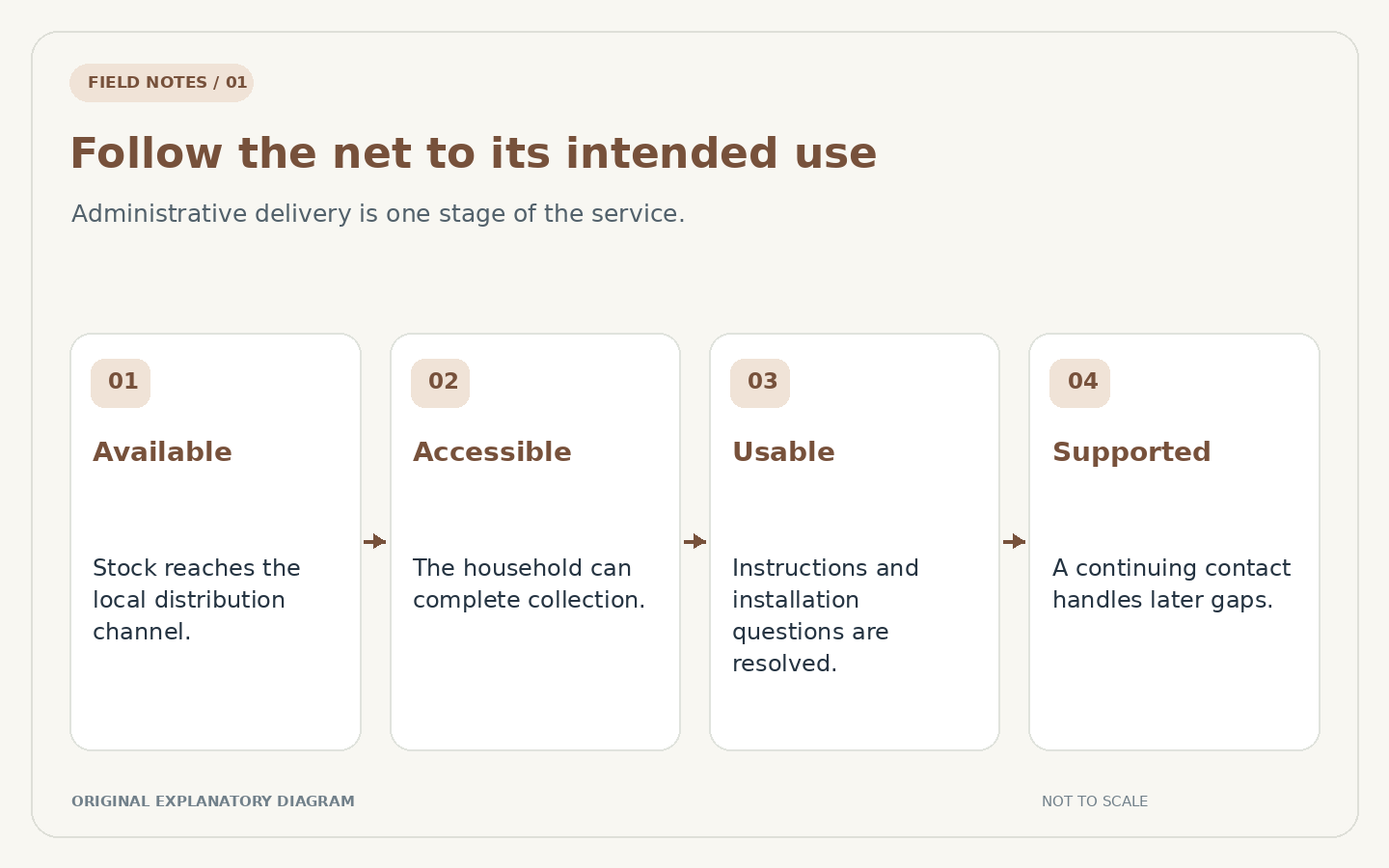
A distribution tally can show that a mosquito net left a storeroom without showing whether it reached an appropriate sleeping space. Between those events lie ordinary practical questions: who was home, whether the household understood the collection arrangements, whether the net could be hung, and whether someone knew where to ask for help. A useful plan makes those steps visible before the first package changes hands.
Imagine a local team preparing a community distribution. Its task is not simply to move stock efficiently. It must make the route from eligibility to usable protection understandable. That requires listening to households as well as counting items. The examples below are planning exercises, not claims about a particular campaign, locality, or organization.
Treat access as an ongoing service
WHO recommends combining mass distributions with continuing channels, including antenatal and immunization services, to maintain access to insecticide-treated nets. It notes that household coverage can develop gaps as nets deteriorate or are lost and as populations change. A successful campaign therefore needs a connection to what happens after its collection dates have ended. [1]
Ask what a household should do if a family member arrives later, a sleeping arrangement changes, or a net becomes unusable. Write the answer in the same place as the initial collection instructions. If the answer is not yet known, identify who is responsible for resolving it. An ongoing service becomes easier to use when the next contact is clear before a problem occurs.
Map sleeping arrangements without collecting unnecessary detail
Household size is useful, but a distribution discussion may also need to understand how people use the available sleeping spaces. Ask only for information relevant to the local program's allocation rules. Avoid collecting names, diagnoses, or other sensitive details merely because a form has room for them. Explain why a question is being asked and how the answer will be used.
Use a simple conversation rather than assuming every home resembles the planning diagram. A sleeping area may be shared, temporary, or rearranged during the day. The practical question is whether the approved net and installation support fit the situation. When a standard arrangement does not fit, record the unresolved need for the responsible program team instead of improvising a potentially unsuitable solution.
Make collection instructions survive everyday conditions
Prepare instructions that answer where, when, what to bring, and whom to contact if collection is missed. Test them with someone who did not write them. If that person cannot explain the next step, simplify the wording before printing more copies. A clear map reference may be more useful than a long address in a setting where landmarks guide travel.
Plan for people who cannot attend the announced session, who do not read the main language, or who receive information through someone else. The appropriate arrangements will depend on the local program, but the questions should be asked explicitly. Separate a logistical exception from a refusal to participate. Otherwise, a missed collection can be recorded as lack of interest when the actual problem was access.
Support installation through the local program
At handover, identify where the product-specific instructions are located and how households can obtain help interpreting them. Ask whether the person collecting the net is the person who will arrange its use. If not, provide a way for the instructions to reach the household intact. A brief explanation can disappear when the recipient is carrying several items or helping someone else through the queue.
Avoid treating a demonstration as proof that every home can copy it. Record questions about dimensions, hanging points, and changing sleeping arrangements for trained local staff. The goal is to connect a real household problem with an appropriate response. A generic reminder to use the net cannot solve a missing installation support route, and repeating the reminder more loudly will not reveal what is missing.
Learn from the distinction between supply and affordability
The historical NetMark project, described by FHI 360, worked with manufacturers and distributors and used approaches intended to expand access to insecticide-treated nets. Its closeout account describes a public-private initiative that operated from 1999 to 2009. That history illustrates how distribution channels and affordability can be separate parts of the same access problem; it does not describe the current ownership or activities of this domain. [2]
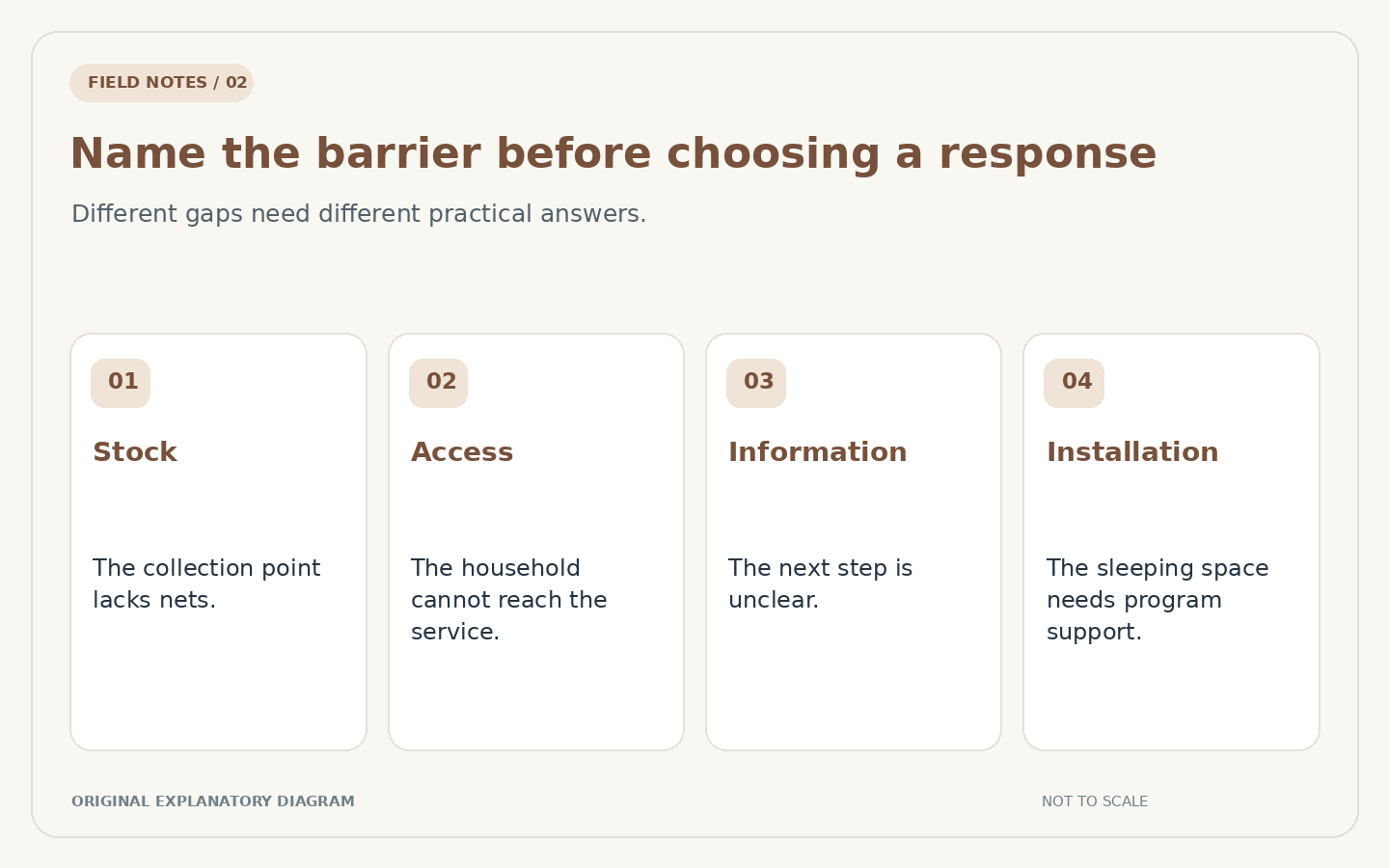
For a contemporary planning exercise, distinguish whether the obstacle is availability, cost, information, or physical access. Each suggests a different response. More publicity will not repair an empty collection point. Additional stock will not help someone who cannot reach it. A useful issue log names the barrier precisely enough that the responsible team can act on it.
Measure the steps that reveal a gap
Use several modest measures instead of asking one total to represent everything. Record stock delivered, households reached, unresolved collection problems, and requests for installation help. These are different events and should keep different labels. If follow-up is permitted and practical, ask whether the household could put the net into use and what prevented that when it could not.
Explain the limits of each measure. A distribution count is an administrative record; a household report describes an experience at a particular time. Neither alone establishes a change in malaria illness. Avoid asking volunteers to infer a health outcome from a successful handover. Keeping the measures distinct protects the usefulness of both the service record and any separate public-health evaluation.
Close problems while people still remember the route
Choose a named contact for unresolved questions and a realistic method for returning answers. Group recurring problems so the team can see whether one confusing instruction affects many households. If a collection point changes, update the channels people actually use rather than relying only on the original poster. A correction that never reaches the intended audience is still an unresolved communication problem.
At the end of the exercise, walk through one household's route from first notice to usable net and future replacement advice. Identify where the person would have to guess. Those gaps are the next planning priorities. A well-designed distribution effort respects the household's time and treats practical feedback as information that can improve the service, not as resistance to the health message.
For example, a follow-up note might record that a household received its allocation but could not interpret the hanging instructions. The next action is a referral to the program's installation support, followed by confirmation that the question was answered. Recording only delivered would hide the problem; recording only not used would hide the service response needed. The fuller account creates a practical task someone can own.
Sources
- Long-lasting insecticidal nets and integrated delivery — World Health Organization
- Decade-long US Project to Fight Malaria Builds Thriving African Mosquito Net Industry — FHI 360